

Choosing the right flooring for your home or business in Ballarat isn’t just about picking a color you like at the local hardware store. It is a significant investment that affects your property value, your daily maintenance routine, and how your space feels during a cold Victorian winter.
When people walk into a modern showroom or a renovated garage, they often point at a shiny, seamless floor and say they want polished concrete. However, more often than not, what they are actually looking at is high-end epoxy. There is a lot of confusion in the flooring industry, and today we are going to clear that up. We will compare the big three: Epoxy, Polished Concrete, and Tiles.
If you are looking for the “best” floor, you need to understand that “best” depends entirely on your specific environment. It is not about which material is objectively superior in a vacuum; it is about which one solves your specific problems.
The Contenders: A Quick Overview
Before we dive into the nitty-gritty of durability and cost, let’s define what we are actually talking about.
Epoxy Flooring is not paint. It is a chemical system consisting of a resin and a hardener. When mixed, they create a plastic-like surface that bonds transitionally to your concrete substrate. It is incredibly tough and customizable.
Polished Concrete is the process of mechanically grinding your existing concrete slab using industrial diamonds, then honing and polishing it until it reaches your desired level of shine. It relies on the quality of the concrete already under your feet.
Tiles are the traditional choice. Whether ceramic or porcelain, they are individual units laid over a screed or adhesive with grout lines in between.

Durability: It Is Not About Hardness, It Is About Resilience
Many people assume that because concrete is hard, polished concrete must be the most durable option. That is a common misconception. While concrete is indeed hard, it is also porous.
Polished concrete looks stunning, but it is susceptible to staining from oils, wines, or acidic liquids if they aren’t wiped up immediately. In a busy Ballarat workshop or a family kitchen, that is a high-risk scenario.
Tiles, on the other hand, are famous for cracking. Drop a heavy pot in the kitchen or a wrench in the garage, and you are looking at a spiderweb crack that is nearly impossible to repair without replacing the entire tile. Then you have the grout. Grout is the weak point of any tiled floor. It absorbs dirt, breeds bacteria, and eventually discolors.
This is where epoxy wins the durability debate. It is a non-porous, seamless barrier. Because it is slightly flexible compared to stone or ceramic, it can withstand impacts that would shatter a tile. It does not have grout lines to scrub, and it is chemically resistant. If you spill oil in your garage, it sits on top of the epoxy until you wipe it away. It is not just a floor; it is a shield for your concrete.
The Aesthetics: It Is Not Just “Industrial” Anymore
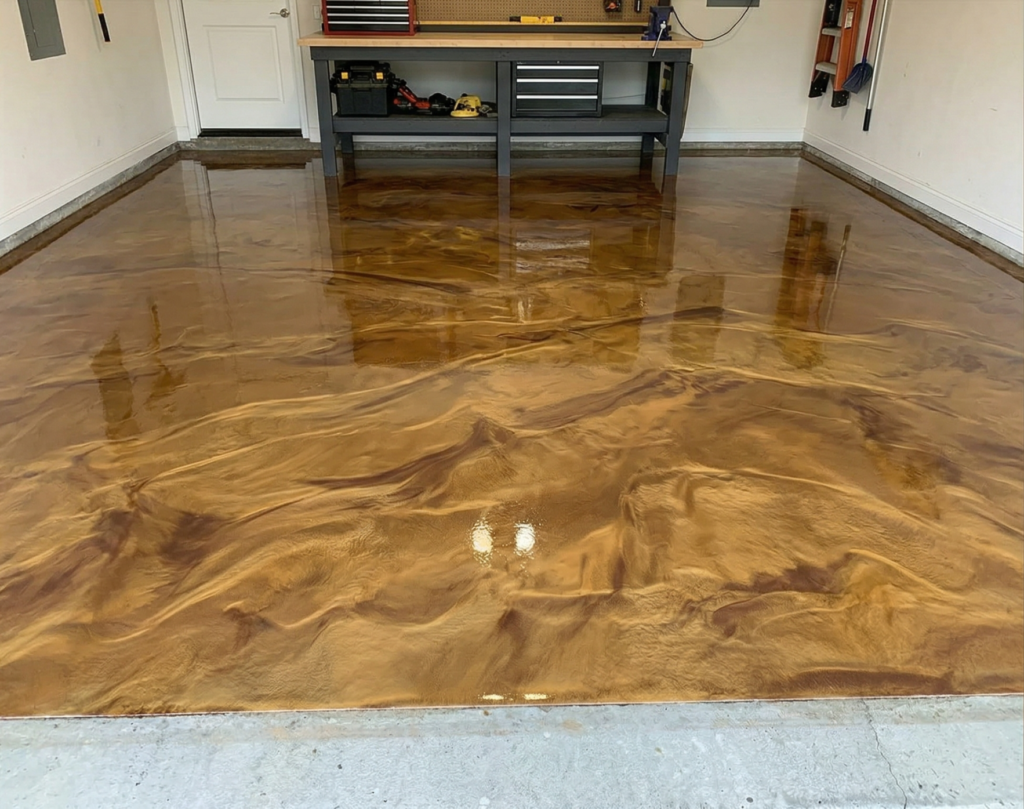
There is a lingering idea that epoxy is only for grey hospital hallways or messy mechanic shops. That is outdated thinking. Modern epoxy systems, specifically “Metallic” or “Flake” finishes, offer a level of aesthetic depth that tiles simply cannot match.
With tiles, your design is always interrupted by a grid. No matter how expensive the tile is, you will always see the lines. This makes small rooms feel smaller.
Polished concrete offers a beautiful, organic look, but you are at the mercy of your slab. If your concrete was poured poorly twenty years ago, or if it has ugly patches and trenching from old plumbing, polished concrete will highlight those flaws rather than hide them.
Epoxy gives you total control. If you want a floor that looks like marbled stone, we can do that with metallic pigments. If you want a granite-look garage floor that hides dust and footprints, a flake system is the answer. It is a “top-down” design approach where we create the look you want, rather than “working with what we’ve got.”
Maintenance: The “Sunday Morning” Test
Think about how you want to spend your Saturday mornings. Do you want to be on your hands and knees with a toothbrush scrubbing grey grout lines back to their original white? Probably not.
Tiles are high-maintenance because of their texture and joints. Polished concrete is easier, but it requires periodic resealing and specialized pH-neutral cleaners to keep its luster.
Epoxy is the king of low maintenance. Because it is a single, continuous surface, there is nowhere for dust or allergens to hide. A quick sweep and a damp mop with a basic cleaner are usually all it takes. For Ballarat businesses, this is a game-changer for OH&S and hygiene standards. It is not just about looking clean; it is about actually being clean.
The Cost Equation: Initial vs. Lifecycle
When homeowners compare quotes, they often look at the bottom line of the invoice. Tiles might look cheaper per square meter at the shop, but have you factored in the cost of the adhesive, the grout, and the professional labor to lay them? It adds up fast.
Polished concrete can also be surprisingly expensive. To get a high-quality “full exposure” polish (where you see all the stones inside the concrete), the labor hours required for grinding are extensive.
Epoxy sits in the “sweet spot.” While it is not the cheapest “quick fix” (like a bucket of floor paint), its lifecycle cost is the lowest of the three. You are paying for a floor that can last 10 to 20 years with proper care. When you calculate the cost per year of life, epoxy is almost always the winner for both residential and commercial properties in Ballarat.
Why Local Expertise Matters
As a Ballarat-based business, we understand the local conditions. Our soil moves, our temperatures swing from 40 degrees in summer to below zero in winter, and our humidity levels vary.
This matters because concrete “breathes.” If you apply a cheap, DIY epoxy kit from a big-box retailer, it will likely peel within a year because it cannot handle the moisture vapor transmission from the ground. We use industrial-grade, 100% solids epoxy and professional diamond grinding equipment to ensure a mechanical bond.
We aren’t just selling you a product; we are applying a technical solution based on years of experience on Victorian jobsites. We know which resins handle the Ballarat frost and which ones stand up to the high foot traffic of a Sturt Street cafe.
The Verdict: Which One Is Right for You?
So, which one should you choose?
- Choose Polished Concrete if: You have a brand new, perfectly poured slab and you want a raw, organic, industrial look and don’t mind the occasional stain.
- Choose Tiles if: You are doing a small bathroom renovation and you want a specific textured pattern that only ceramic can provide.
- Choose Epoxy if: You want the most durable, easy-to-clean, and customizable floor available. If you want a floor that can handle a car, a spilled coffee, or a heavy tool drop without flinching, epoxy is the answer.
It is not just about covering your floor; it is about finishing your space with a material that works as hard as you do.
Ready to transform your Ballarat property?
Contact us today for a free quote!